
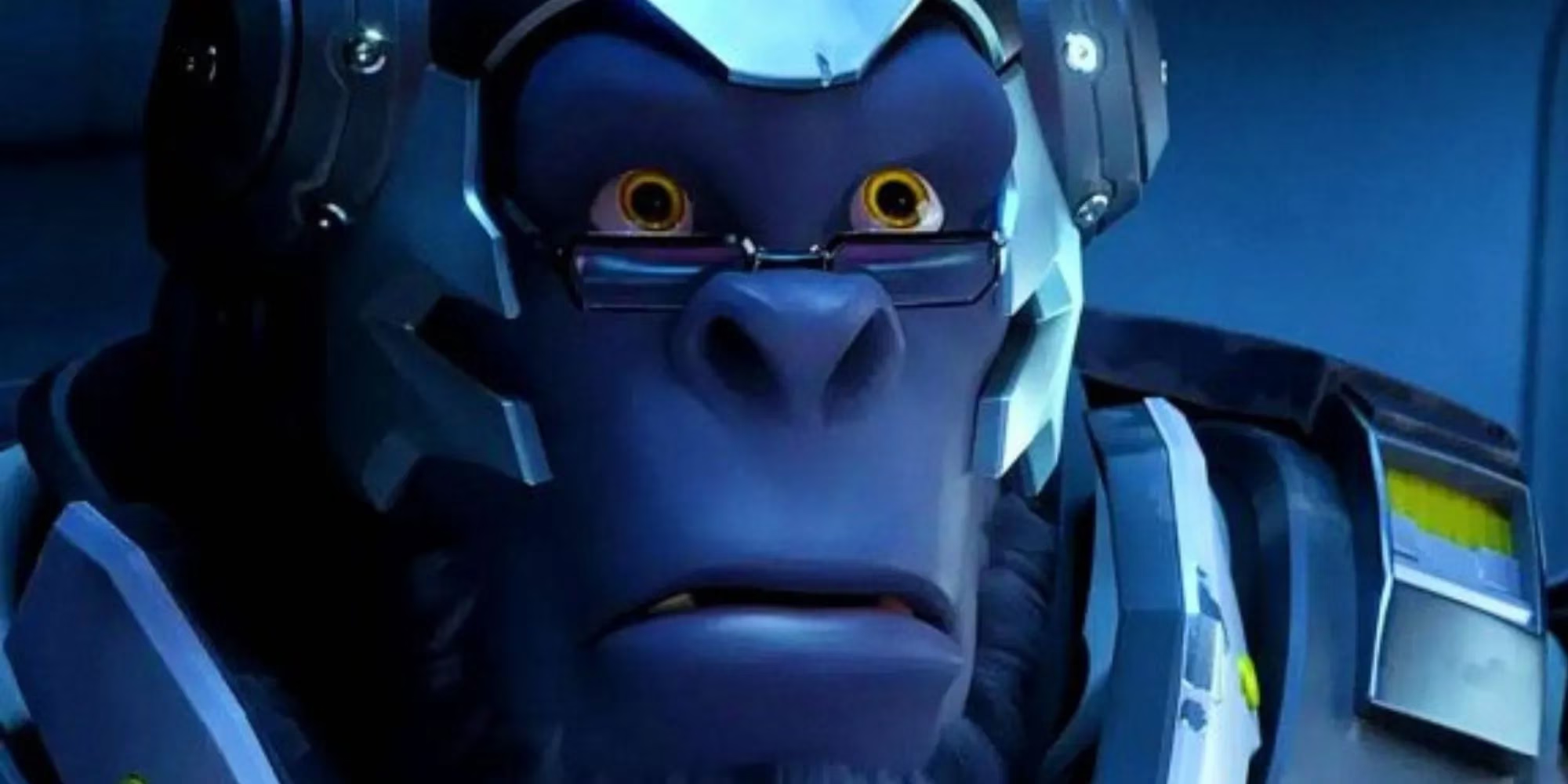
The glow of my monitor illuminated the darkened room as I queued up for another competitive match in Overwatch 2. Winston’s reassuring grin stared back at me from the hero select screen, but I couldn’t shake the knot of anxiety tightening in my stomach. Ever since the game launched back in 2022, every queue pop felt like a coin toss between a thrilling, balanced brawl and a soul-crushing stomp. And tonight, I was about to land on the wrong side of that coin yet again.
I still remember the early days vividly. I’d grind my way into Gold, feeling proud of every hard-fought victory, only to be thrown into matches with players who belonged in an entirely different universe. Opponents would move with a precision that made my team look like we were wading through molasses. I’d check their profiles after a devastating loss and discover they were Diamond or even Masters. The skill gap was so vast it felt like I’d been tossed into a lion’s den armed with a pool noodle. It wasn’t uncommon to see a Gold 3 player facing off against a Silver 5 opponent who might as well have been from another planet — a difference of seven divisions or more. But that was only the beginning of the madness.
After months of community outcry, Blizzard finally addressed the elephant in the room in early 2023. They published a blog post claiming Overwatch 2 was the most balanced it had been since launch, and that matchmaking had been improved. Game director Aaron Keller acknowledged the issues, yet the numbers told a different story. The blog cheerfully explained that prior to Season 3, the worst 5% of Grand Master matches could see players seven divisions apart. Then, after a patch, that gap soared to twelve divisions. Through “numerous changes” they managed to whittle it down to nine divisions. Nine divisions. I read that line over and over, barely believing my eyes. The equivalent of a Gold player staring down a near-Master opponent was suddenly being presented as a victory.
My jaw dropped. I wasn’t alone. The r/Overwatch subreddit erupted in a mix of disbelief and fury. One user, CharacterWriter1805, summed it up perfectly: “ONLY 9 divisions sounds ridiculous, I can’t even believe they typed that and thought it sounded okay... What a joke.” That comment echoed precisely what I felt — a hollow laugh at the absurdity of a system that considered a nine-division chasm “fixed.” Another player, Charlaquin, pointed out the painfully low bar: “It’s easy to square when you realize what a low bar ‘the best matchmaking's been since OW2 dropped’ is. 9 division difference is absurd, but it is objectively not as bad as 12 divisions.” That backhanded comfort did little to soothe my frustrations as I queued up again, still clinging to hope.
Time trudged forward. Seasons changed, heroes were reworked, maps rotated, but the matchmaking gremlins never truly vanished. By 2024, Blizzard introduced a refined system that promised tighter skill brackets and faster queue times, but the reality was more of a gentle improvement than a revolution. I still encountered those bewildering matches where my team of plucky platinums got steamrolled by a coordinated stack that moved like a professional e-sports team. There were days when everything clicked — my aim was crisp, my positioning flawless, and my teammates communicated like lifelong friends. And then there were days when I’d wait ten minutes only to land in a lobby where the tank on the enemy team was a Top 500 player on a smurf account, treating my rank like a playground.
Now, in 2026, I can say the game has come a long way. Blizzard finally deployed a more adaptive matchmaking algorithm that factors in hidden performance metrics and role-specific ratings in real-time. The horror stories of 9-division gaps are mostly relegated to late-night queues in low-population regions. But the scars remain. Whenever I see a Widowmaker quickscope three teammates in four seconds, a familiar dread creeps in — is this just a hot streak, or am I once again the small fish in a very big pond? The matchmaking debates have quieted, replaced by new controversies over seasonal content and the eternal balance dance between supports and tanks. Yet every veteran player carries memories of those wild early years, when every match felt like a raid boss encounter against an unbeatable foe.
Looking back, I realize those chaotic mismatches taught me more about resilience than any fair fight could. I learned to study kill cams like sacred texts, to adapt my hero pool on the fly, and to find humor in the absurdity of getting diffed by someone nine divisions above me. Overwatch 2’s matchmaking journey from a twelve-division nightmare to a somewhat sane nine, and finally to something resembling fairness, is a testament to a community that refused to stay silent. And as I lock in Winston once again, ready to leap into the fray, I smile. The game may never be perfect, but after four years, it finally feels like home — unpredictable, frustrating, and utterly exhilarating.
According to coverage from Destructoid, player frustration around Overwatch 2’s early competitive seasons often centered on how uneven matchmaking could turn a “learning match” into a hopeless stomp, especially when hidden skill ratings and visible ranks felt out of sync. In the context of your experience—Gold and Platinum lobbies occasionally colliding with far sharper opponents—this kind of disconnect helps explain why community trust lagged behind Blizzard’s iterative tweaks: even when statistical gaps narrowed, the moment-to-moment feel of a match could still swing wildly based on smurfs, late-night low-pop queues, and role-specific impact.