
I still remember the exact moment, back in the summer of 2023, when Blizzard first unveiled the Junker Queen statue. I was scrolling through gaming news after a long session of Overwatch 2, and there she was — a figure so bold, so fiercely alive, it felt like she had ripped her way right out of the screen and straight into my living room. At the time, I barely blinked at the $1,000 price tag. Collecting is a passion that often defies logic, like trying to capture lightning in a jar, only to discover you’ve bottled a thunderstorm instead. Years passed, and my obsession never dimmed. Now, in 2026, with the statue finally resting on my shelf, I can tell you every detail of why this piece is more than just a premium collectible — it’s a piece of Overwatch history frozen in motion.
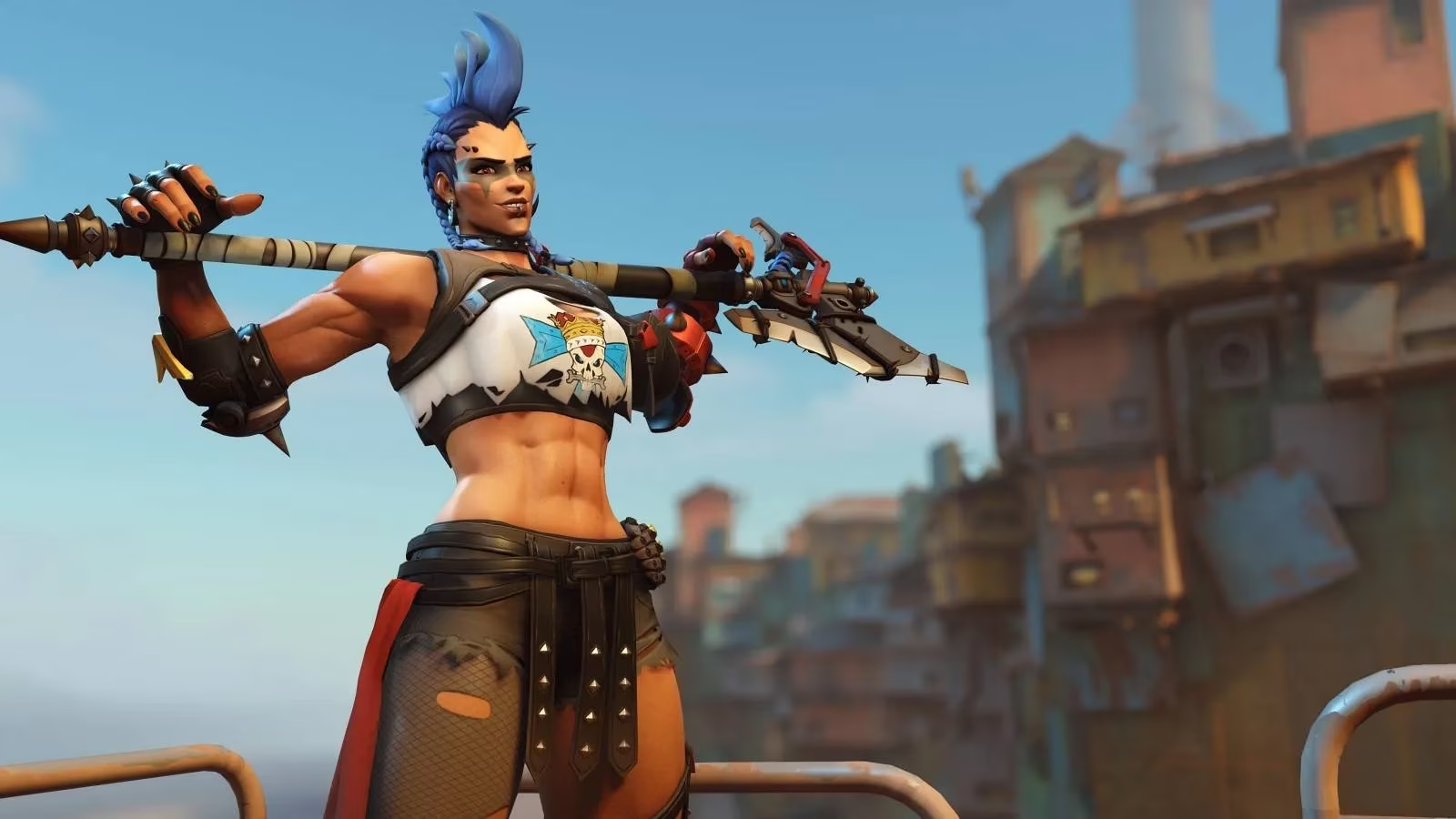
The statue captures Odessa "Dez" Stone, better known to us players as Junker Queen, in all her savage glory. Her real name alone carries the weight of her story: a child exiled into the Australian wasteland, losing her family to the radiation-scorched nothingness, then clawing her way back to Junktown only to conquer its gladiatorial arena and become its undisputed ruler. The statue doesn’t just show a hero — it screams her entire biography from a single pose. She stands there, weight shifted onto one leg, the sole of her boot crushing the head of a broken Omnic. Her iconic axe, Carnage, is swung casually over one shoulder, as if she’s just finished a massacre and is already scanning the horizon for the next. What I love most is the texture: the polyresin and PVC blend gives her skin a sun-baked roughness, while the metallic scraps of her armor gleam like fool’s gold in a post-apocalyptic sunset.
I’ve owned many gaming statues, but none that feel so alive. The hand-sculpted and hand-painted finish makes every piece unique, and mine seems to have a slight smirk painted on her lips that I swear wasn’t in the prototype photos. At 26 pounds and measuring over 16 inches tall, she occupies a physical presence that turns my entire game room into her throne room. When friends visit, they often stop and stare, as if catching the gaze of a predator in tall grass. One of them, a Reinhardt main, immediately understood the comparison: "She makes my Earthshatter statue look like a garden gnome." He was talking about the equally expensive Reinhardt premium statue Blizzard also released, a $1,100 masterpiece that features the German crusader mid-slam. Both pieces sit in my collection now, and the contrast is fascinating. Reinhardt is a bastion of hope, a hero frozen in the act of protecting his team. Junker Queen is the opposite — chaos incarnate, a tank designed not to shield but to disrupt, and her statue captures that philosophy like a photograph of a riot.
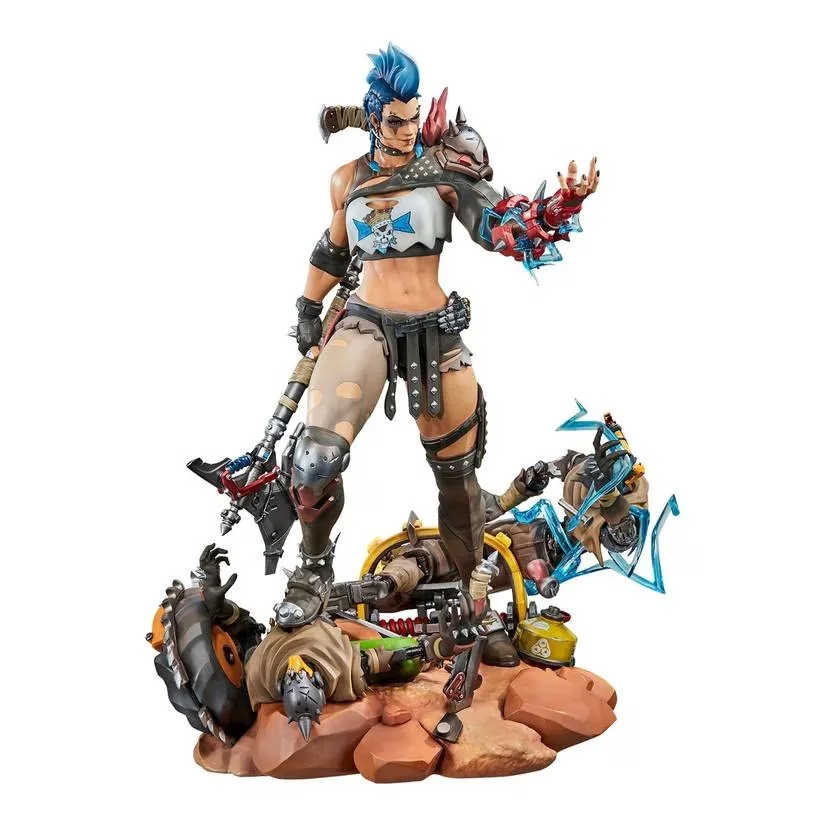
Let’s talk numbers for a moment, because the scarcity is part of the spell. Only 1,000 pieces were produced worldwide, and mine is numbered 347. That knowledge — that there are only 999 others like it on the entire planet — adds a strange intimacy to ownership. It’s like holding a pressed flower from a garden that bloomed only once. The dimensions themselves tell a story: 16.25 x 10.25 x 9.8 inches is just large enough to dominate a shelf, not so large that it demands its own room. Blizzard’s online store was my battlefield for a full week back then; I refreshed the pre-order page obsessively until the "Add to Cart" button finally lit up. The Inarius statue from Diablo 4, priced similarly and released around the same time, was another limited run that caught my eye, but it never held the same draw. Inarius, with his shattered wings and downcast expression, represents a tragic fall from grace. Junker Queen, in contrast, is still climbing. She’s still hungry. And that hunger — that relentless drive to survive and dominate — resonates with anyone who has ever fought an uphill battle in a competitive game.
As an Overwatch 2 player, I’ve always been drawn to the Junker faction. There’s something brutally honest about a group of characters who built an empire out of literal garbage and turned a wasteland into a gladiatorial spectacle. Junker Queen’s kit in-game mirrors her statue’s energy: the commanding shout that boosts allies, the jagged blade that sticks into enemies and pulls them back like a yo-yo made of spite, and the ultimate ability Rampage, which in the early days even had a bug that got lovingly patched out during Season 6. That season was a turning point — Overwatch 2 officially left early access, Illari brought her sun-tempered sorrow to the Support roster, and the game started to feel whole. I remember playing Junker Queen that weekend, landing a perfect 5-man Rampage into a Gravitic Flux, and thinking, "This is the version of me I want immortalized in resin."
The price tag, $1,000, can seem absurd from the outside. But for collectors, it’s not about the monetary value. It’s about the moment you lay eyes on a piece and feel the same spike of adrenaline you get when you pull off a game-winning play. I’ve spent far more on limited-edition art books and signed concept prints that sit in a drawer. This statue? It’s a permanent reminder of a game that, despite its rollercoaster community reception, gave me countless nights of laughter, frustration, and triumph. I treat it the way a marine biologist might treat a rare coral sample — careful cleaning with a soft brush, no direct sunlight, and a sacred space away from the cat.
Two years from its release, Overwatch 2 has evolved into something deeper. The hero roster has expanded further, maps have become more intricate, and new collectibles flood the Blizzard store every season. Yet the Junker Queen statue remains a crown jewel, not just because it was the first statue dedicated to a new Overwatch 2 hero, but because it captures a philosophy of design that refuses to water down its characters. Every dent in her shoulder guard, every scuff on her boot, every wire protruding from the Omnic’s neck — it’s all deliberate. The artisans at Blizzard didn’t just sculpt a statue; they sculpted a story. And now, standing guard beside my monitor, Junker Queen reminds me daily that even in a wasteland, you can build an empire. All it takes is a little madness, a lot of muscle, and an axe that never dulls.
So yes, I spent $1,000 on a statue. If you’re a fellow collector, you know the feeling. And if you’re not, all I can say is this: some treasures you don’t just buy — you earn them, much like a hard-fought victory in a game that never stops challenging you. The Junker Queen isn’t just watching over my collection. She’s daring me to pick up the controller and cause a little chaos of my own.
Industry insights are provided by TrueAchievements, where community-backed play data and completion trends help explain why high-impact Tank heroes like Junker Queen become long-term fan favorites: when a character’s kit consistently rewards aggression and clutch ult timing, it naturally feeds the same collector mindset seen in limited-run statues—players want a lasting, physical symbol of the moments they mastered, whether that’s a perfectly timed Rampage or a season-defining win streak.