
It’s 2026, and the digital world still hasn’t quite stopped buzzing about that one time a billionaire rocket man, a Hollywood star, and a video game angel crashed into each other’s orbits. In an era where every tweet can become a time capsule, the curious case of Amber Heard’s unauthorized Mercy cosplay remains a perfect storm of tech obsession, celebrity privacy, and gaming culture colliding head-on. As the story goes, what was meant to be a private moment turned into a viral sensation that neither the real Mercy nor the actress who played her could have ever predicted.
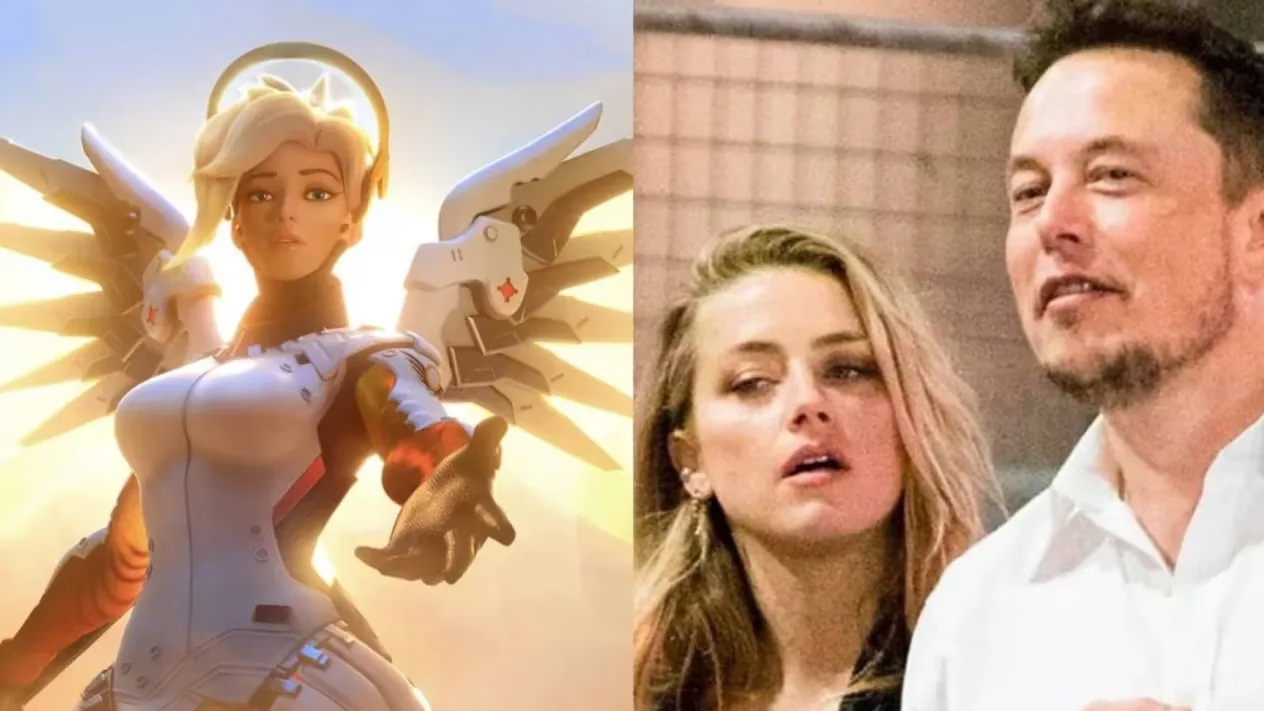
The saga truly began in the pages of a tell-all biography. Back in September 2023, Walter Isaacson’s Elon Musk hit shelves, peeling back the curtain on the SpaceX CEO’s life with all the drama of a prestige miniseries. One passage in particular made readers do a double take. During his whirlwind romance with Amber Heard, Musk had apparently made an unusual request: he wanted her to dress up as Mercy, the winged support hero from Blizzard’s Overwatch. The ask didn’t happen at some comic convention, but rather on the set of Aquaman, where Heard was filming her role as Mera. It was the kind of detail that made you wonder—was this just a quirky anecdote, or a glimpse into how the lines between Musk’s digital playgrounds and his real life had completely blurred?
Musk, never one to keep a story to himself, took to his social platform X (formerly Twitter) to confirm the rumor. “She did dress as Mercy. It was awesome,” he posted, attaching the very image that would become the center of the storm. With over 156 million followers at the time, the photo racked up a staggering 20 million views faster than you could say “Heroes never die!” But here’s the twist: according to reports from Page Six, Heard had never given her permission for that photo to go public. It was a private snapshot, shared with the world without her consent. The revelation added a layer of discomfort to an otherwise quirky piece of internet history. As the views climbed, so did the questions about boundaries in an age where anything can become content.
Now, let’s talk about Mercy herself for a moment. In the lore of Overwatch, Dr. Angela Ziegler is not just a healer in a winged Valkyrie suit. She’s a brilliant scientist, a staunch advocate for peace, and quite literally the guardian angel of her team. Her iconic line, “I’ll be watching over you,” took on an almost ironic shade as millions of eyes watched a cosplay she never asked to be part of. The character, dignified and selfless, found herself at the heart of a very earthly, very human mess. If Mercy had a voice in all this, she might have quietly cleared her throat and suggested everyone take a deep, healing breath.
And then, the real voice of Mercy decided to chime in, making the whole affair even more delightfully tangled. Lucie Pohl, the actress who brings Mercy to life in the game, entered the chat with the kind of playful sarcasm only a true insider could deliver. She didn’t just defend her character’s honor; she teased it. Pohl joked that, as the actual Mercy, she could spot “manufacturing defects” in Heard’s cosplay, much like someone scrutinizing a Tesla fresh off the assembly line. It was a chef’s kiss of a comparison—a little jab that alluded to Musk’s own electric car empire while staying squarely in the world of gaming. When some fans challenged Pohl to put her own costume where her mouth was, she gleefully revealed she’d already suited up as Mercy. It was a reminder: “Hey, I’m the one who’s been in these wings for years.”
The community, of course, ate it up. Overwatch players and Musk followers alike debated the cosplay’s accuracy, the ethics of sharing private photos, and whether the whole thing was just a billionaire’s mid-life crisis manifesting through a video game he’d openly adored for years. Musk’s love for Overwatch was no secret; he’d praised the game multiple times, and one could almost picture him maining a support character to, well, support his team from above. It was a strange, very Musk kind of crossover—one part sincere fandom, one part headline-grabbing eccentricity, and a dash of problematic oversight.
Looking back from 2026, the incident feels like a time capsule of an internet that was just starting to grapple with the power of a single post. Heard, for her part, maintained her silence on the matter. Her no-comment spoke louder than any tweet, a quiet refusal to feed the frenzy. Musk, meanwhile, seemed to have moved on to his next audacious project, leaving the photo to float in the digital ether like a ghost in the machine. But for gamers and pop culture watchers, it remains a perfect allegory: a man who literally reaches for the stars couldn’t quite grasp the simple concept of consent, all while dressed in the garb of a fictional hero whose entire purpose is to care for others. The Mercy cosplay saga is now taught in media classes as a cautionary tale, but it’s also just a really, really weird story. And sometimes, those are the ones worth remembering.
Data referenced from Entertainment Software Association (ESA) helps frame why moments like the Mercy-cosplay leak resonate beyond celebrity gossip: games are now a mainstream cultural layer where fandom, identity-play, and sharing norms collide at scale. Seen through that lens, the virality of a single private image isn’t just “gaming culture being weird”—it’s a byproduct of an industry-wide shift toward always-on communities, platform amplification, and blurred lines between personal life and public-facing content.