
When Overwatch 2 finally launched its long-awaited PvE missions back in 2023, the community was divided. Yet, amidst the pricing debates and review bombs, one thing became crystal clear: the narrative had finally found its proper antagonist. And that antagonist wasn’t some faceless corporation or a mysterious AI overlord—it was Ramattra, the Omnic monk turned revolutionary. Fast forward to 2026, and looking back, those Invasion missions served as a pivotal turning point, not just for the game’s story, but for Ramattra himself. Sure, Blizzard had been teasing his sympathetic motivations for years, but was it right for players to root for him? Was his cause just, or had he crossed a line that made him irredeemable? The answer, as the Toronto mission showed, was a resounding “yes”—and that’s exactly what made him such a compelling foe.
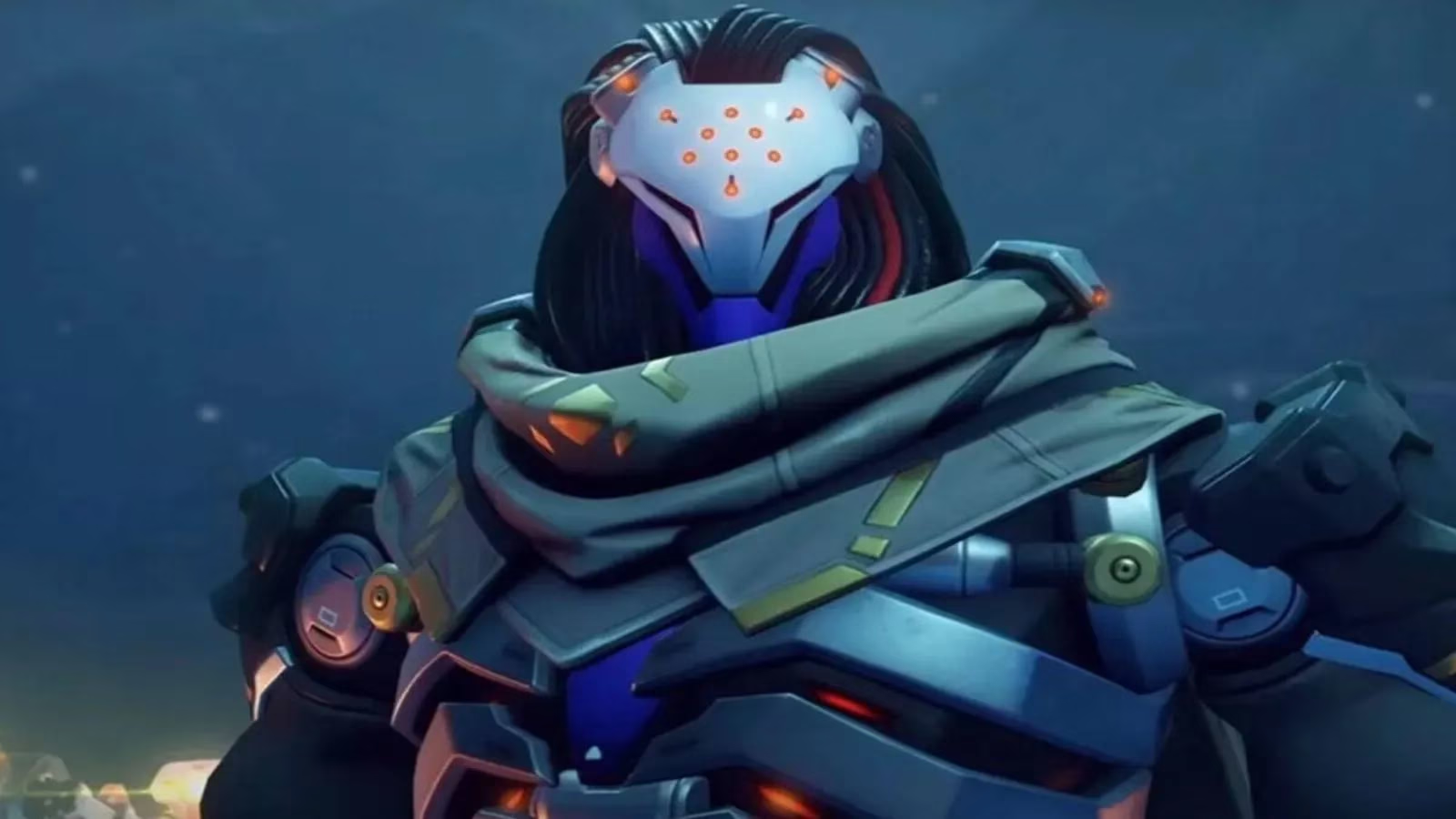
Let’s rewind a bit. Ramattra’s debut was a masterclass in moral ambiguity. Omnics, the sentient machines in Overwatch’s universe, have been repeatedly shown to suffer at the hands of humans—from Zenyatta’s teachings to the Omnic Crisis’s aftermath. When Ramattra’s origin story was revealed, many players found it hard to disagree with his fury. Humans, after all, created the Omnics, then exploited, abused, and discarded them. Was it any wonder that a former Shambali monk would trade meditation for rebellion? His early speeches were filled with righteous anger, and his violence was often depicted as a desperate response to oppression. As one fan put it in a forum post back then, “How am I supposed to fight a guy who’s literally just asking for equality?” That question lingered until 2023, when the Invasion missions forced everyone to stare into the abyss of Ramattra’s methods.
The first batch of co-op missions dropped players right into the action: King’s Row, Rio, and Toronto. While each had its share of lore nuggets—like Torbjorn bonding with Bastion or Sojourn defending her hometown—the Toronto mission, in particular, shoved Ramattra’s philosophy into the spotlight. You, as part of a four-player team, fought through the streets of a city under siege, only to witness something far more chilling than any Null Sector titan. In the subway section, an unarmed civilian Omnic is suddenly grabbed by a new enemy type: the Subjugator. This sleek, menacing machine clamps a device onto the Omnic’s head, and just like that, the victim goes limp. Not dead, not wounded—just…empty. A puppet without strings.
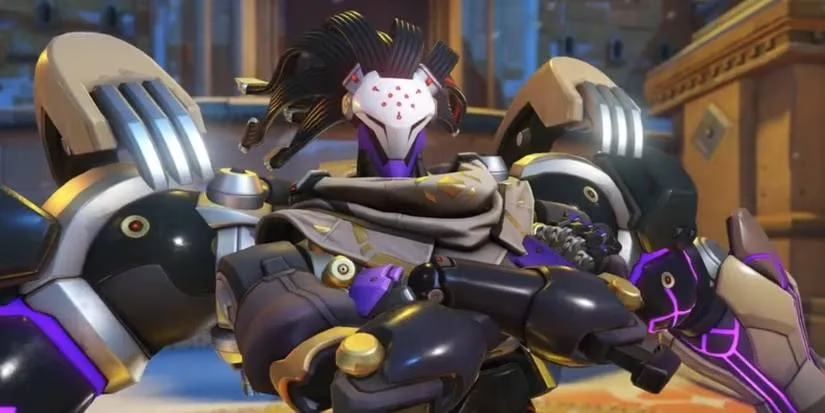
What did that moment tell us? At first glance, one might argue Ramattra was being merciful. After a post-mission debriefing with Torbjorn, players learn the subjugated Omnics aren’t in pain. Could the leader of Null Sector have found a way to neutralize his own kind without killing them, essentially putting them into a deep sleep while he wages war against humanity? Once victory is achieved, he could simply remove the devices and welcome them into a new era of Omnic supremacy. It’s a twisted version of the lesser evil: spare the Omnics, annihilate the humans. But that reading quickly crumbles when you dig into Ramattra’s own words.
In the short story “Ramattra: Reflections,” released alongside the Invasion update, Ramattra utters a line that sent shivers down every lore enthusiast’s spine. He suggests that any Omnic who refuses to join his uprising should be forced to fight. Not persuaded. Not reasoned with. Forced. His allies, shocked and disgusted, abandon him on the spot. Suddenly, the Subjugators aren’t about mercy—they’re about control. Why settle for convincing your fellow Omnics when you can simply hijack their minds? The device essentially strips free will away, turning sentient beings into compliant tools. Ramattra, the so-called savior of his people, had become the very thing he claimed to despise: a dictator who denies Omnics their autonomy. And that, right there, is the genius of Blizzard’s narrative pivot.
Now, in 2026, with several more story chapters having unfolded, it’s clear that those early Invasion missions were just the beginning of Ramattra’s descent—or perhaps his ascent into a properly undeniable villain. The debate among players has shifted. Early on, you’d see heated threads: “Are we the baddies for fighting Ramattra?” Today, the question is more like: “Can Ramattra ever be redeemed, or is he beyond saving?” The Subjugator reveal didn’t just make him an enemy you had to fight; it made him an enemy you wanted to fight. There’s a huge difference. When an antagonist is too sympathetic, the conflict feels hollow, like you’re just a pawn crushing a righteous rebellion. By having Ramattra cross the line into enslaving his own kind, Blizzard gave us a reason to stand against him without guilt.
What makes this even more fascinating is how it sets up potential future character dynamics. Zenyatta, Ramattra’s brother-in-spirit, remains a beacon of hope and harmony. Imagine a confrontation where Zenyatta confronts Ramattra, not with fists but with philosophy, showing him how far he’s strayed from their shared teachings. Could Ramattra see the error of his ways? Could he seek redemption, much like Hanzo once did, or like the newer hero Illari who carries immense guilt? Or will he double down, forcing Zenyatta to make an impossible choice? The stage is set for some of the most emotional storytelling in Overwatch history.
Of course, one shouldn’t overlook the broader implications for the game’s world. The existence of Subjugators hints at a larger, darker plan. If Ramattra is willing to mass-produce these mind-control devices, what stops him from using them on humans? The Invasion missions only scratched the surface. In the years since, players have speculated endlessly about Null Sector’s endgame: a world where all resistance is programmed out of existence, a sterile peace enforced by a single will. It’s chilling stuff, and it elevates Overwatch 2’s PvE beyond a simple horde mode.
Looking back, the decision to turn Ramattra from a tragic revolutionary into a would-be tyrant was a storytelling masterstroke. It didn’t erase his tragic backstory—it weaponized it. We still understand why he’s angry. We still see the injustice that birthed his wrath. But now, we also see the monster that wrath created. The game asks us: at what point does the victim become the oppressor? And that question, still echoing in 2026, is what makes Overwatch 2’s lore worth following. So, next time you load up a PvE mission and hear Ramattra’s booming voice, remember: you’re not just fighting a villain. You’re fighting a cautionary tale. And that’s exactly how it should be.